
Events
Energy Management in the Steel Industry: A 58% Reduction in Energy Intensity Over 6 Decades

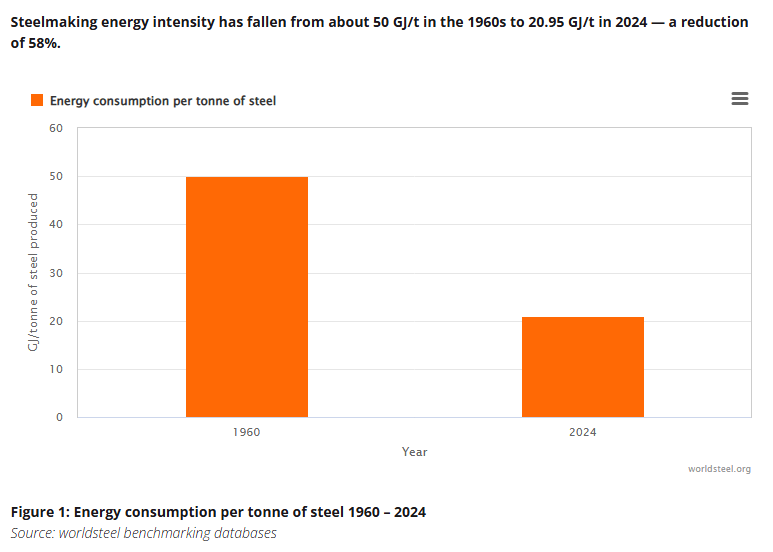
According to a new World Steel Association report, the global steel industry, through proactive energy management, has succeeded in reducing its energy intensity from about 50 gigajoules per ton in the 1960s to 20.95 gigajoules per ton in 2024, which represents a 58% improvement. This achievement comes as global crude steel production reached an unprecedented 1.849 billion tons in 2025, and demand is expected to continue to rise with population growth and the development of low-carbon energy infrastructure.

Energy consumption in the steel industry depends heavily on the production route. In the traditional blast furnace–basic oxygen furnace (BF-BOF) route, coal, with a share of 70 to 80 percent, is the main energy source, while in the scrap-based electric arc furnace (EAF) route, electricity, with a share of 50 to 70 percent, plays the key role. In addition, the by-product gases generated in coking, blast furnace and oxygen processes supply more than 60 percent of a steel plant’s energy needs and play a central role in improving energy efficiency. Based on data collected from the association’s members, the share of renewable energy in the industry’s total energy consumption reached 1.94 percent in 2024.

On the path to transforming the steel industry, companies are seeking to improve efficiency, gradually electrify processes, and develop projects based on hydrogen and electric arc furnaces. The World Steel Association has estimated that the transition to low-carbon production requires investment of more than 1.2 trillion dollars to build and adapt new facilities and another 2.5 to 4 trillion dollars for the supply chain. However, the coal-based blast furnace–basic oxygen furnace route is expected to hold a major share of global production for at least the coming decades, and the transition to clean technologies requires access to affordable clean energy and massive investment.